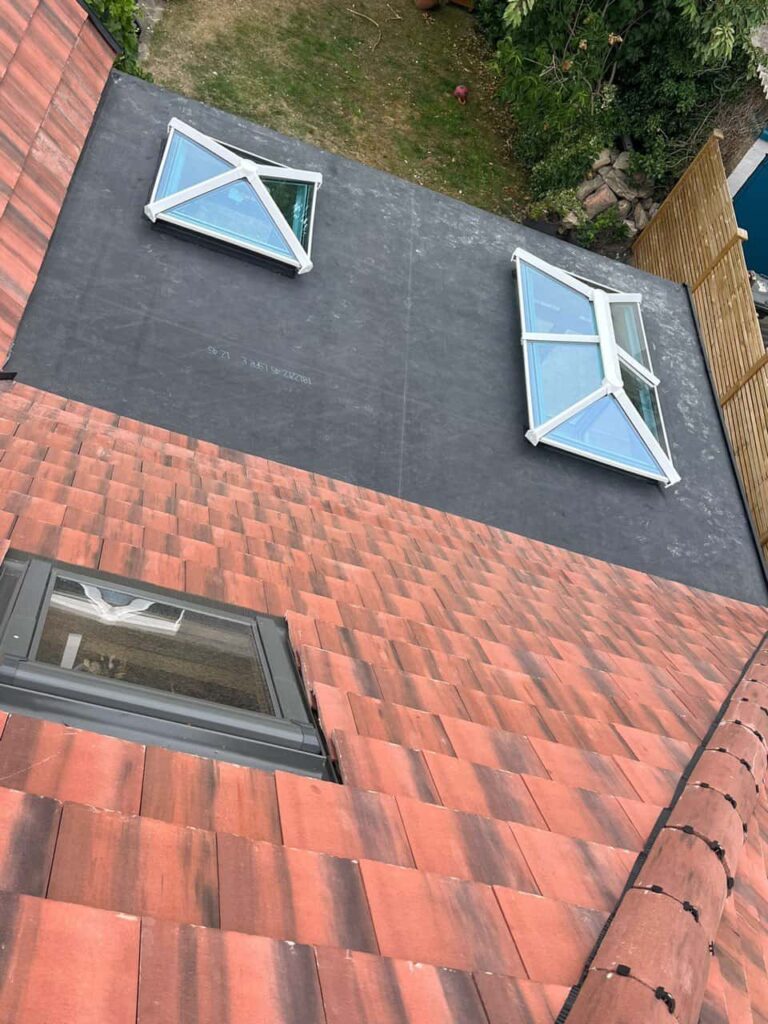
A roof can appear reasonably sound from the outside while deterioration is developing beneath the visible covering. Tiles or slates may remain largely in position, yet problems with underlay, battens, fixings or repeated moisture ingress can affect the roof’s ability to continue performing reliably. In these circumstances, what appears to be a relatively small repair may reveal a more extensive problem once the affected area is properly investigated.
For homeowners in Rugeley, Staffordshire, hidden deterioration does not automatically mean that a complete roof replacement is necessary. Much depends on how widespread the damage is, which roofing components are affected and how much dependable material remains. A professional roof assessment is therefore important for distinguishing between a repairable local defect and deterioration significant enough to make replacement the more appropriate solution.
When Can Hidden Roof Deterioration Lead to Replacement?
Roof replacement becomes more relevant when deterioration extends beyond one clearly defined defect and affects a substantial proportion of the roofing system. A successful local repair depends on having sound materials around the damaged area to work with.
If investigation reveals that those surrounding components are also deteriorating, repeatedly repairing individual symptoms may no longer provide a dependable solution. The condition beneath the visible roof covering therefore plays an important part in deciding how extensive the work should be.
The Visible Roof Covering Does Not Tell the Whole Story
Tiles and slates provide the most obvious indication of roof condition, but they are only one part of the construction.
Beneath them are supporting and weather-resistant components that help the roof function correctly. These areas are largely concealed during normal use, which means deterioration can sometimes progress without producing obvious external warning signs.
A roof can therefore look comparatively tidy while weaknesses are developing underneath.
This is why the external appearance alone should not be used to determine whether a roof needs minor repair or more extensive attention.
Water Ingress Can Affect Areas Beyond the Original Leak
A small point of water entry can sometimes affect a much larger area beneath the covering.
Once moisture passes through a roofing defect, it may travel along underlay, battens or other components before becoming visible inside the property. The location of a ceiling stain therefore does not necessarily identify the exact point where the roof has failed.
Repeated moisture exposure can also affect materials away from the original defect.
When investigating a leak, assessing the surrounding roof helps establish whether deterioration remains localised or has extended into areas that are not immediately visible.
Deteriorated Battens Can Change the Extent of a Repair
Roof battens provide important support for tiles and form part of the fixing arrangement.
If a slipped or damaged tile is removed and the batten beneath it remains sound, the repair may be relatively straightforward. If the supporting timber has deteriorated across a wider area, simply replacing the visible tile would not resolve the underlying weakness.
The extent of batten deterioration matters.
A small affected section can potentially be dealt with locally, whereas deterioration extending across substantial parts of a roof slope can make broader renewal more appropriate.
Ageing Underlay Can Remain Hidden Until Problems Develop
Roofing underlay sits beneath the primary covering and is therefore difficult to assess from outside without opening sections of the roof.
Over time, its condition can change. Problems may only become apparent when tiles are disturbed during repair work or when water ingress reveals that the underlying protection is no longer performing as expected.
Limited underlay deterioration does not automatically justify replacing the complete roof.
However, where the material has become extensively degraded across large areas, the practical extent of the work required to renew it may significantly influence the repair-or-replace decision.
Repeated Tile Slippage Can Reveal Problems Beneath the Surface
Occasional tile movement can result from an isolated damaged tile or fixing.
Repeated slippage across the same section deserves closer investigation because the visible tiles may only be showing the effects of deterioration beneath them. Supporting battens, fixing points or other components may no longer be providing consistent support.
Continually repositioning individual tiles without examining why they keep moving can result in recurring repairs.
Identifying the condition beneath the covering helps determine whether attention should remain localised or extend across a larger section.
Hidden Deterioration Around Roof Junctions Can Cause Persistent Leaks
Roof junctions are particularly important because several materials often work together to prevent water ingress.
Areas around chimneys, valleys and roof-to-wall junctions may contain flashing and other weatherproofing details that are not fully visible from ground level. Deterioration within these areas can create persistent or intermittent leaks.
If the surrounding roof remains sound, repairing the junction may be sufficient.
Where opening the area reveals deterioration extending into neighbouring roofing components, the required work can become more extensive.
Previous Repairs Can Conceal a Wider Pattern
A roof that has received several repairs over many years may contain sections of different ages and conditions.
There is nothing inherently wrong with this. Effective repairs can substantially extend the useful life of otherwise serviceable roofing.
The situation changes when new defects begin developing between or beneath several older repairs. Investigation may reveal that the remaining original materials have deteriorated while the repaired sections themselves remain sound.
At some point, another small repair may involve disturbing several existing areas simply to reach increasingly unreliable original roofing.
Recurring Leaks Can Suggest That the Problem Is More Extensive
One isolated leak can often be traced to a specific defect.
When water ingress repeatedly returns despite previous repairs, it becomes increasingly important to assess the wider roof rather than assuming each occurrence is unrelated.
The original leak may have been incorrectly located, deterioration may have spread, or several components may now be contributing to the problem.
Recurring water ingress does not automatically mean replacement is necessary, but it provides a strong reason for a more detailed assessment of both visible and concealed roofing components.
Hidden Damage Can Be Localised
Discovering concealed deterioration should not immediately lead to the conclusion that an entire roof has failed.
If the affected material is limited to a clearly defined area and dependable roofing surrounds it, a larger localised repair may be sufficient. The damaged components can potentially be renewed while retaining sound materials elsewhere.
This is an important distinction.
Professional assessment should establish the boundaries of deterioration rather than recommending replacement simply because additional damage was discovered during an inspection.
When Does Local Repair Become Less Practical?
A local repair relies on being able to connect new work reliably with the existing roof.
This becomes more difficult when deterioration extends in several directions or when surrounding materials are themselves becoming unreliable. Repairing one component may require progressively opening larger sections until sound roofing is reached.
At that stage, the distinction between an extensive repair and replacement of the affected section becomes increasingly small.
The appropriate decision should consider how much dependable existing construction can realistically be retained.
Widespread Deterioration Can Make Replacement More Appropriate
Replacement deserves serious consideration when inspection reveals that deterioration is not confined to the area where symptoms first appeared.
Examples can include extensive problems with battens or underlay, widespread tile or fixing deterioration, repeated leaks across several areas and substantial sections where reliable repairs would require extensive dismantling.
The important factor is the overall pattern.
When numerous roofing components are deteriorating together, replacement can provide a more coherent solution than continuing to address each emerging weakness individually.
Replacement Does Not Always Mean the Entire Roof
Hidden deterioration may affect one roof slope more severely than another.
Where a clearly defined section has deteriorated extensively but neighbouring areas remain dependable, replacing only the affected section may sometimes be appropriate.
This is why the extent of deterioration needs to be established carefully.
The objective should be to renew what genuinely requires replacement while retaining serviceable roofing wherever doing so remains practical and dependable.
Roof Age Provides Context, Not the Final Answer
An older roof is more likely to contain components that have experienced prolonged weather exposure, but age alone does not determine whether replacement is necessary.
Some older roofs remain serviceable because their materials and previous repairs continue to perform effectively. Conversely, hidden problems can develop in a roof that appears relatively sound externally.
Condition should therefore take priority over assumptions based purely on age.
A detailed assessment provides a more reliable basis for deciding what work is appropriate.
Signs That Hidden Deterioration May Be Present
Some problems can justify further investigation even when extensive damage is not visible externally. These include:
- recurring or unexplained water ingress;
- several tiles repeatedly slipping from the same area;
- increasing numbers of roof defects;
- damp appearing in different internal locations;
- deterioration around roof junctions;
- repeated problems near previous repairs;
- visible sections of roofing becoming uneven;
- repairs that do not provide a lasting resolution.
None of these signs proves that replacement is required. They indicate that understanding what is happening beneath the visible surface may be necessary before another repair is planned.
Why Professional Roof Assessment Matters
The purpose of a professional assessment is not simply to identify damaged tiles or visible leaks. It is to determine how far the problem extends and whether the surrounding roofing remains dependable.
This is particularly valuable where concealed deterioration is suspected.
A careful assessment can prevent a minor problem from being unnecessarily treated as a complete roof failure. Equally, it can identify when an apparently straightforward repair would leave substantial deterioration unresolved.
The appropriate solution lies in understanding the complete condition of the affected area.
Professional Roof Assessment in Rugeley, Staffordshire
At Rugeley Roofing Repairs, we understand that the most visible roofing defect is not always the only problem requiring attention.
Where appropriate, assessing the affected area alongside surrounding materials and previous repair history can help establish whether deterioration remains localised or extends further beneath the roof covering. This allows the recommended work to reflect the actual condition of the roof rather than assumptions based solely on appearance.
For homeowners in Rugeley, professional diagnosis can provide valuable clarity when deciding whether a roof remains suitable for repair or whether more extensive renewal should be considered.
Conclusion
Hidden deterioration can make roof replacement necessary when damage extends significantly beyond the visible defect and affects substantial areas of the roofing system. Deteriorated battens, ageing underlay, recurring water ingress and increasingly unreliable surrounding materials can all influence whether another local repair remains practical.
However, discovering concealed damage does not automatically mean that the complete roof needs replacing. Localised deterioration can often be addressed while sound roofing elsewhere is retained.
The key is establishing the true extent and cause of the problem. If you are experiencing recurring roof problems or are concerned about hidden deterioration at your property in Rugeley, Staffordshire, contact Rugeley Roofing Repairs. We can assess the affected roofing and recommend an appropriate repair or replacement approach based on what the roof genuinely requires.
Call us on: 01889 227 295
Click here to find out more about Rugeley Roofing Repairs
Click here to complete our contact form and see how we can help with your roofing needs.